
What it means
4. About 51 lakh more employees come under PF, pension and insurance.
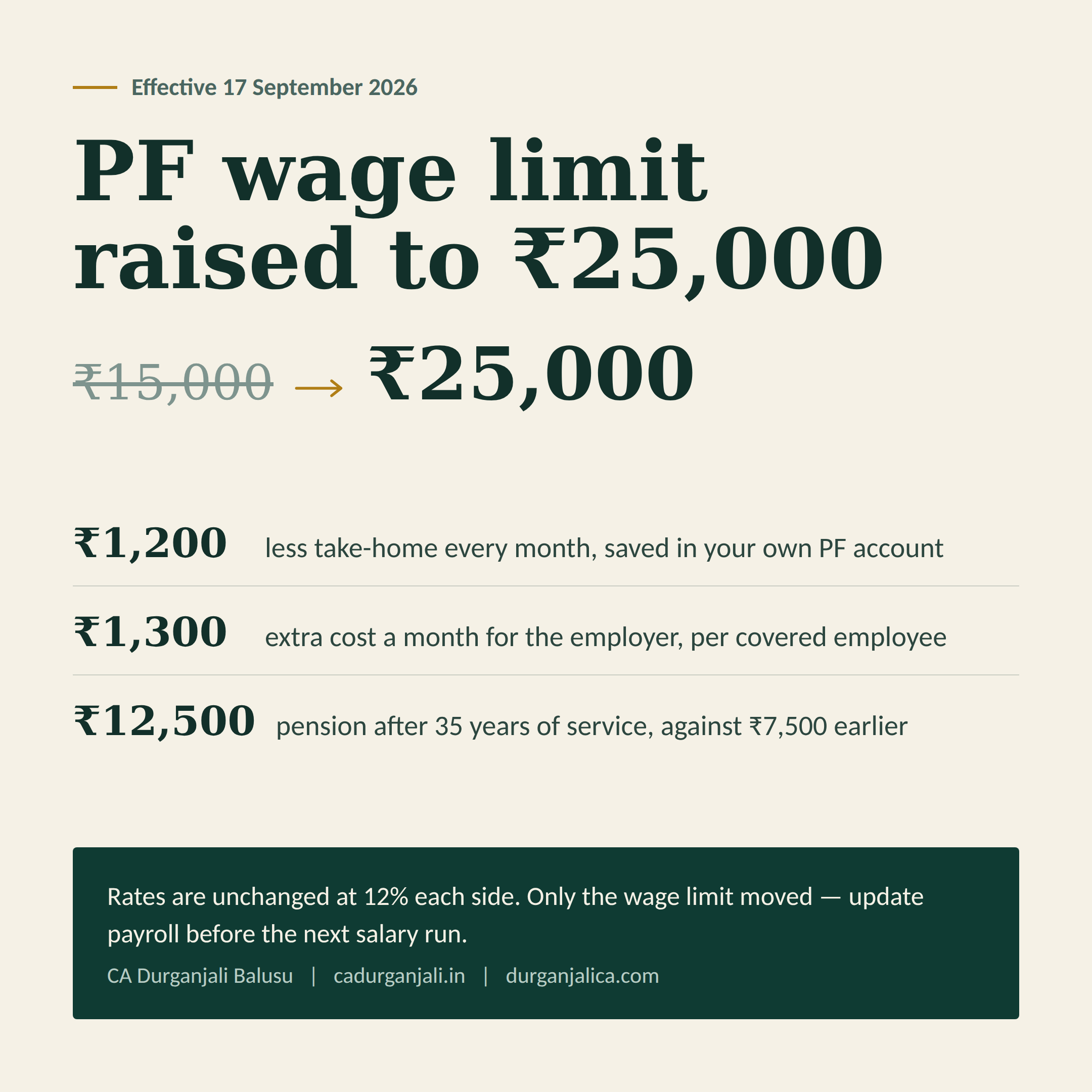
5. Rates unchanged: 12% employee, 12% employer. Only the wage limit changed
6. Example: employee with basic + DA of ₹30,000, PF earlier restricted to ₹15,000.
7. Earlier: ₹1,800 from employee, ₹1,800 from employer.
8. Now: ₹3,000 from each side.
9. Take-home falls by ₹1,200 a month.
10. Employer’s cost rises by about ₹1,300 a month, ₹15,600 a year per employee.
11. The employee has not lost the ₹1,200. It has moved from his pocket to his PF account.
Who is covered now
12. Every new joiner earning up to ₹25,000 must be covered.
13. Existing staff kept out earlier because they joined above ₹15,000, but now within ₹25,000, must be brought in.
14. Someone joining above ₹25,000 stays outside, unless employer and employee both agree in writing.
15. Employees above 58 have no pension share. The full employer contribution goes to PF.
Precautions for employers
16. Make a list of affected employees in three groups: never enrolled, capped at ₹15,000, and those already on full wages.
17. Update payroll software before the next salary run, and test a few employees first.
18. Inform employees before deducting, not after.
19. Do not cut salary or allowances to recover the extra cost. Fine up to ₹50,000.
20. Never deduct the employer’s share from the employee’s salary. Same penalty.
21. Do not restructure salary to reduce basic. If allowances cross 50% of total pay, the excess is added back to PF wages.
22. Deposit PF by the 15th of the next month, without exception.
23. Late deposit of the employee’s share means the income tax deduction is lost permanently.
24. Delay also brings interest, damages, and prosecution in serious cases.
25. For contract labour, get proof from the contractor that he has applied the new ceiling. Otherwise the liability is yours.
26. September is a split month. The ceiling changed on the 17th, and EPFO has not clarified the treatment yet.
27. Some are calculating proportionately, others are applying ₹25,000 for the full month. Follow one method for everyone and keep the working in writing.
28. Paying less carries interest and damages. Paying more only costs money.
29. If any employee should have been covered in earlier years and was missed, use the Employees’ Enrolment Campaign, 2026, open till 31 October 2026.
30. Under that campaign, the employee’s share is waived where it was never deducted, and damages are only ₹100.
31. Keep a file: the notification, your working, the employee list, and the communication sent to staff.
Precautions for employees
32. Check your PF passbook every month against your salary slip.
33. If the deduction shows on the slip but not in the passbook, raise it immediately. That employer faces a minimum one year imprisonment.
34. Activate your UAN and link your Aadhaar, PAN and bank account.
35. File your e-nomination today. It takes five minutes online.
36. Without nomination, your family will struggle to claim your PF and insurance.
37. Do not withdraw PF on every job change. Transfer it instead.
38. Pension needs ten years of service, so every withdrawal resets your savings.
39. Your pension is now calculated on ₹25,000 instead of ₹15,000.
40. For 35 years of service, that means about ₹12,500 a month instead of ₹7,500.
41. Free EDLI insurance cover also rises, up to a maximum of ₹7 lakh, at no cost to you.
Two more points
42. The employer’s extra contribution is a business expense, so it reduces tax.
43. Employers may recover part of the cost through the PMVBRY scheme, up to ₹3,000 per month per eligible new employee. Check the conditions before relying on it.
44. The ESI limit is separate and has not changed. Do not mix the two.